China has launched what it claims is the world’s first 6G satellite into space in order to test new spectrum bands that will be used to power future networks.
The development of 6G is still at a very early stage and it is still unclear what network technologies will form a commercial standard and what use cases will emerge. This means the satellite will contain very little ‘6G technology’.
There is a consensus however that the addition of integrated intelligence and new spectrum will deliver superior speeds, capacity, and latency.
These characteristics, it is argued, will overcome current technological limitations - such as the limited processing capability of mobile devices – to enable truly immersive extended reality (XR), high-fidelity mobile hologram and digital twin applications.
However, it is widely expected that 6G networks will be powered by terahertz (THz) spectrum that will deliver significant advances in speed and capacity. indeed, it is anticipated that 6G will up to 100 times faster than 5G.
It is this spectrum that will form the focus of these satellite experiments. Specifically, the satellite will test the performance of terahertz spectrum in space, believing the new frequencies will enable lossless transmission and long-distance communications with lower power consumption.
The hope is that 6G powered by terahertz spectrum could provide a major enhancement to satellite internet services that have traditionally been constrained by speed, capacity, and latency issues.
There are several research initiatives around the world focusing on 6G development. In addition to China, the €251 million 6Genesis programme is already well underway in Northern Finland. The US also has 6G ambitions and Samsung is keen to expand its influence into the world of networks.
It is thought a standard could be finalised by 2028 with commercial launches starting in 2030.
IBM is launching an open hybrid cloud platform for the telecoms industry, claiming it will help operators modernise their infrastructure and unlock the full potential of 5G networks.
5G will deliver superior consumer services but the real potential is in the business market. Ultrafast speeds, enhanced capacity and ultra-low latency will allow mobile networks to power mission-critical applications for the first time and allow for the creation of entirely new use cases.
However, this requires operators to rearchitect networks away from centralised, legacy core infrastructure and towards the cloud. By virtualising network functions, operators can rollout new services more rapidly, dynamically allocate resources to where they are most needed, and bring processing capabilities closer to the point of collection.
This necessity has seen significant convergence between the telecoms and technologies industries in recent years as vendors from both spheres collaborate to create joint-offerings that mix and match various IT and network technologies.
‘IBM for Telecommunications’ comprises a cloud platform and ecosystem of third-party vendors that promise to aid operators achieve this transition by allowing services to be built or deployed wherever they or their clients require – in the cloud, on-premise or at the edge.
The scalability of IBM’s ensures operators can easily meet growing demand for data and voice, while powerful software layers simplify the management of infrastructure, enable automation, and reduce costs. Operators can maximise data assets and rapidly roll out new services that meet customer requirements and drive revenues.
Beyond the core cloud platform, IBM has created an ecosystem of more than 35 partners, including major telecoms network manufacturers, software vendors, and hardware specialists. This includes Cisco, Dell, Intel, HPE, Nokia and Samsung.
As part of the project, Nokia and IBM will create a fully-functioning cloud-based 5G network that will allow operators to quickly provision private 5G services for enterprises, while IBM will work with Samsung and Red Hat to create AI-based services for Industry 4.0 deployments.
“We believe that our service provider customers will benefit greatly from having an additional choice to quickly and efficiently deploy private 5G networks,” said Jane Rygaard, Head of Edge Cloud, Nokia. “The transition to 5G will be a key step for industries to deliver on their digital transformation plans. Having multiple options of cloud-based solutions will help our industry build this path forward.”
Rivals Microsoft and Google have both made significant investments in their telco capabilities both in terms of creating new services and through acquisitions.
Virgin Media has made its gigabit broadband service available to three million homes in London and Northern Ireland following the latest phase of its nationwide network upgrade programme.
The new additions bring coverage up to 6.8 million premises across the UK, roughly 45% of Virgin Media’s footprint, with several major cities able to access speeds in excess of 1Gbps.
The gigabit service is delivered through a combination of fibre-to-the-premise (FTTP) and cable infrastructure and upgrades can be done remotely without the need to install cabinets or cables. The plan is to ensure the entirety of the Virgin Media’s network by the end of 2021.
Although the rollout predates Coronavirus, the company hopes to capitalise on demand for faster broadband speeds from households increasingly reliant on their connection for entertainment and work during lockdown.
Indeed, the pandemic would appear to have vindicated the firm’s decision to invest in ‘futureproof’ infrastructure.
“It has never been clearer that our services play a vital role in supporting people’s everyday lives and powering the economy,” said Lutz Schüler, Virgin Media CEO. “The nation needs next-generation connectivity and we’re delivering.
“Our ambitious target will see us roll-out gigabit speeds across our entire network of more than 15 million homes by the end of next year. As our rollout continues at a speed and scale unmatched by anyone else, whatever the future holds, we’re keeping our customers and the country connected to what’s next.”
Virgin Media is one of several broadband providers investing in ultrafast broadband. Openreach plans to connect 4 million properties to full fibre by March 2021 and up to 20 million by the end of the decade. Meanwhile ‘alt net’ providers like CityFibre, Gigaclear and Hyperoptic are also rolling out fibre to the premise (FTTP) networks.
Earlier this year parent company Liberty Global agreed to merge Virgin Media with Telefonica's O2 in a £31 billion deal that will create a converged communications giant in the UK.
BT’s network, offices and retail stores across the world are now powered entirely by renewable energy, a significant milestone in the company’s bid to become a net zero carbon business by 2045.
The telco is the joint-largest private buyer of electricity in the UK and was already using renewable sources of energy for its British operations.
However, it has now increased the global figure from 92% over the past few months.
"As an organisation that consumes nearly 1% of the UK’s electricity, it is important for BT to demonstrate its commitment to a green recovery,” said Cyril Pourrat, Chief Procurement Officer at BT. “Our team has worked hard to secure renewable electricity contracts for our sites globally, a crucial step towards the Paris agreement’s 1.5°c target.”
Since 2016 BT has reduced its carbon emission intensity by 42% and has reduced emissions in its supply chain by 8% during the same period. It also helped customers save 13 million tonnes of carbon last year alone – three times its own emissions.
Reducing the environmental impact of its 33,000 vehicles is a big focus of the company’s sustainability drive and there are plans to switch a third of Openreach’s fleet to electric by 2025.
BT has played a significant role in the creation of the UK Electric Fleets Alliance through a partnership with The Climate Group. The organisation promotes electric vehicle adoption and infrastructure across the UK and develop supporting policies.
There are also plans to factor progress on carbon emissions targets when calculating bonuses, adding further incentives to the workforce. The firm publishes an annual sustainability report.
Complaints are a part of life in the telecoms industry. Communication is now so important to society that any issue with coverage, speed or reliability is considered unacceptable.
Like a referee in football, mobile and broadband customers only tend to talk about their provider when something goes wrong. Customer grievances are often justified but it can be frustrating – especially in a highly competitive marketplace – when positive news is drowned out.
The industry has traditionally suffered from an image problem but recent events have elevated the role of connectivity within society. Although this also means greater scrutiny, there is an opportunity to highlight the positive role that providers play too.
BT’s internal communications team hopes that by engaging its workforce more effectively, staff will spread the news among friends and family, helping to boost the reputation of the company. To this end it is now using Workplace by Facebook, an enterprise social network, to share news and encourage discussion.
Although BT was already using other collaborations such as Microsoft Teams, it believed Workplace could play a vital role in establishing a company culture. With 100,000 staff located across the UK and the world in different business units, it could take time for company news to disseminate across the organisation.
BT concluded Workplace’s mobile-first nature, coupled with usability features borrowed from Facebook, would be far more successful than company-wide emails. New stories can videos are shared immediately, and BT can have open, real-time dialogue with staff whether they work in a call centre, the shop floor, or as an engineer. A post from CEO Philip Jansen can be commented on by anyone within the organisation.
“We had a gap in our channel landscape when it came to social,” explains Anna Epps, internal communications director at BT to TechRadar Pro.
“We didn’t have a user-friendly way to connect to each other and access company news in between meetings. We could have built an in-house news app … but Workplace supports the culture we’re trying to build – it’s fast paced, easy to use, and shares news in real time. It’s a more authentic way of communication as it doesn’t require scripted interviews etc.”
“Our overall ambition in internal communications is to create a community of advocates and that’s why we chose Workplace,” adds Helen Willetts, director of internal communications. “[Staff] can see our advertising, our campaigns, and what we’re doing and advocate BT as a great place to work. Workplace normalises this.
“Content on Workplace allows us to be reactive. We do polls and ask for opinions so we can get instant feedback and get totally different views. We can see what employees think of things we’re changing and what we do.”
(Image credit: BT)
Phased deployment
Deployment was a phased process so the tech team could identify how staff would use the platform, identify best practices, and ways to encourage adoption. It is now being used by 80,000 staff in 180 countries, with 50 million connections made in 2020 alone. BT has also seen three million 'reactions' and 970,000 comments so far.
The internal comms team hopes to reach the entirety of the workforce but believes 80% adoption is a huge success.
The project was already on track prior to the Coronavirus pandemic but Workplace has played a crucial role in connecting staff and sharing developments at a time of uncertainty.
Like its competitors, BT is proud of the role it played during the first few months of lockdown. As the country became increasingly reliant on their mobile and broadband connections for work, entertainment, and communication, the company worked to ensure its networks could handle the additional demand and to keep customers connected.
Engineers and customer service agents were assigned key workers status and BT promised not to furlough or cut any jobs for the foreseeable future. As the firm shifted towards remote working, Workplace was proving its worth in helping staff adapt to the ‘new normal’ and cope with what has been a challenging time for many.
“Workplace has helped us have that connection between people and leaders at this time,” says Epps. “It has allowed us to focus on the wellbeing of our staff and the importance of connection, not just on company news.”
“As an anti-isolation mechanism, it’s been so helpful,” agrees Willetts. “We definitely couldn’t have achieved what we have without Workplace.
“There have been some amazing content experiences because Workplace is low-production in a good way so we can share [authentic] content. You see the CEO coming in each week and people can share something that’s good about the company to friends and family.”
Shell’s home energy and broadband division has emerged as a surprise contender for Post Office’s telecoms business.
Sky News says the oil and gas giant is competing with Sky and TalkTalk – two of the UK’s biggest broadband providers – in a bidding war that will be welcomed by Post Office, which has half a million landline and broadband customers.
It is thought any deal could be worth £100 million and that Post Office could retain the division should it not receive a satisfactory offer.
While Sky and TalkTalk would welcome the opportunity to expand their customer bases, a takeover would have far greater implications for Shell, which entered the UK market through the 2018 acquisition of First Utility.
Shell has since rebranded the retail division as ‘Shell Energy’ and is intent on becoming a major player in home utilities. It is thought the company has around 800,000 energy customers but has steadily increased its broadband subscriber base to more than 100,000 through cross-selling activities. The addition of Post Office’s customers would be transformative for the business.
TalkTalk, which is currently the subject of takeover speculation itself, declined to comment to TechRadar Pro, as did. Sky, Shell Energy and Post Office have also been contacted.
Verizon and Microsoft are to offer private 5G and edge computing services to businesses customers in the latest evidence of growing convergence between the telecoms and IT industries.
Although 5G will result in more advanced consumer mobile data services, most operators consider the technology’s real potential to be in the business market.
5G promises ultrafast speeds, greater capacity, and ultra-low latency – characteristics that will allow mission critical business applications to be powered by a mobile network for the first time.
Such qualities will also pave the way for the creation of new, revolutionary use cases. These include the Industrial Internet of Things (IIoT), robotics and Mixed Reality, all of which require reliable, real-time transmission of data.
Edge computing is essential for the ultra-low latency as it processes data as close as possible to the point of collection. Meanwhile, private 5G infrastructure provides a high degree of control, increases efficiency, and enhances security.
Verizon and Microsoft will combine their respective technologies to assist customers with their technological requirements and will look to co-develop new services for industries including retail, transportation, and logistics.
“By bringing together Verizon’s 5G network and on-site 5G Edge platform with Microsoft’s expertise in cloud services, we will enable the development of the next generation technologies everyone has been envisioning,” said Rima Qureshi, chief strategy officer at Verizon.
“By leveraging Verizon’s 5G network integrated with Microsoft’s cloud and edge capabilities, developers and businesses can benefit from fast, secure and reliable connections to deliver seamless digital experiences from massive industrial IoT workloads to precision medicine,” added Yousef Khalidi, head Azure for Operators at Microsoft.
Microsoft is already working with Nokia and has made a series of acquisitions to support its 5G ambitions. Las month it launched ‘Azure for Operators’
The relationship between technology and telecoms is set to intensify in the 5G era as vendors combine their networking capabilities with powerful cloud services that result in entirely new services that maximise the opportunity for all parties involved.
Microsoft has been particularly active, working closely with Nokia, making a series of network-related acquisitions, and launching the ‘Azure for Operators’ suite of cloud services for operator partners.
TalkTalk is considering a £1.1 billion takeover offer from investment firm Toscafund – a year after the telco rejected a larger bid of £1.5 billion from the same suitor.
The previous bid valued TalkTalk at double its share price but the company’s board ruled that it did not provide sufficient value to shareholders and customers.
News of the proposal emerged earlier in 2020, prompting Tosca to comment publicly on the matter. The firm said it understood the reasons why its offer was rejected and reiterated its support for the current board and management, adding that the company was in a much better place than when it made its original bid.
However, over the past year, Tosca has increased its stake in TalkTalk from 19% to 29% - roughly the same as executive chairman Sir Charles Dunstone – and has returned to the negotiating table with a lower offer of 97p per share.
“The Board has considered the terms of the Proposal and has agreed to progress the Proposal further with [Tosca] along with taking advice from the Company's advisers,” TalkTalk said in a statement to investors, which also outlined Tosca’s desire to gain the support of Dunstone.
“A further announcement will be made as and when appropriate.”
It’s unclear when Tosca’s 2019 bid was made but a possible reason for the lower offer could be the fact that TalkTalk no longer has a fibre network. Last year, the company said it was seeking as much as £1 billion to fund the expansion of ‘FibreNation’ – a wholesale alternative to Openreach for TalkTalk, Sky and other broadband providers. However, FibreNation was sold to CityFibre for £200 million in January.
There has been a surge of interest from private equity firms in telecoms infrastructure in recent times because of the long-term predictable revenues and room for growth.
However, TalkTalk’s customer base of four million customers is still an attractive proposition as the UK market shifts towards convergence and as the company seeks to migrate subscribers from copper to fibre broadband.
TalkTalk and think tank SM Research say businesses and consumers face higher broadband bills in six months’ time unless Ofcom reviews regulation on Openreach.
Openreach’s dominant market position – the majority of the UK’s broadband services are powered by its infrastructure – mean its services and activities are subject to price caps and regulatory measures.
If wholesale prices rise, then partners will have to increase the prices they charge their customers if they want to maintain margins.
TalkTalk argues the decision to allow Openreach to increase wholesale prices by inflation rather than cost fails to protect households who are increasingly reliant on their connection since lockdown and could threaten the UK’s post-Coronavirus economic recovery.
It suggests the bill for a typical British business could rise by £2,000 over five years – an increase of 11% – while a mid-sized hospital could witness an increase of £8,000, a 7% rise over the same period. Overall, it is estimated the overall cost will be £10 million to hospitals and £500 million to businesses.
The decision to focus on hospitals given their role in the fight against Coronavirus and the timing of the announcement to coincide with the Conservative Part’s virtual conference is a deliberate attempt to force the government into action.
TalkTalk wants the government and Ofcom to reconsider an “uncompetitive system that has made these prices possible” and “carry out affordability assessments that reflect tough new economic circumstances since Covid.”
It also believes Openreach should face scrutiny for failing to keep promises on competition and to offer affordable prices to customers and has cast further doubt on the company’s ability to fulfil the government’s fibre rollout targets.
“When the Prime Minister promised this time last year gigabit connectivity for everyone by 2025, we were front of the queue to applaud him,” declared Tristia Harrison, TalkTalk CEO.
“The problem is this target is in serious danger of being missed. Investment into Britain’s full fibre rollout is critical. But it’s got to be affordable – people cannot be forced to pay higher prices just to increase the profits for those building the network.
“So TalkTalk is asking the Government and Ofcom to make sure that competition thrives and that prices are fair for hard-pressed Britons. It cannot be right that hospitals will end up paying thousands of pounds more for their broadband when economic times are tough.”
An Openreach spokesperson said: “We've launched a number of recent offers for our new, ultra-reliable, full fibre broadband network - and we're encouraged to see those generating strong demand from major ISPs across the market.
"We intend to build the highest quality network, with the biggest footprint in the UK and we'll continue to work closely with our customers to develop propositions that work for them whilst safeguarding competition in the market. We have a legal obligation to treat all of our customers equally and we take that obligation very seriously. That means our full fibre products will always be available to every ISP in the UK under the same prices terms and conditions."
Microsoft’s push into the telecoms market continues with the launch of a dedicated suite of cloud services called ‘Azure for Operators’, hoping to capitalise on increased demand from telcos in the 5G era.
Whereas previous generations of mobile technology have been powered by centralised, legacy core infrastructures, 5G is seeing operators rearchitect their networks around cloud-based cores and network function virtualisation (NFV).
These technologies allow operators to rollout new services more rapidly, dynamically allocate resources to where they are most needed, and bring processing capabilities closer to the point of collection. This will result in superior mobile data services and enable entirely new applications.
Azure for Operators comprises both infrastructure and application elements and hopes to accelerate this shift even further and help telcos realise more of the benefits that businesses in other industries have realised from cloud adoption.
The cloud allows operators to reduce the total cost of ownership of infrastructure and provides the flexibility to react to changing customer behaviours. This agility also enables for the rapid deployment of new services and the ability to automate and virtualise more processes, driving further cost-efficiencies.
On the application side, customers receive access to Microsoft innovations in Artificial Intelligence (AI) and the Internet of Things (IoT) and bake these capabilities into new services. These include network slicing, mixed reality and industrial IoT applications that rely on ultra-low latency, the latter of which is further aided by Microsoft’s growing edge computing environment.
Recognising that operators might have some issues with ceding control of key parts of their network to a third party, Microsoft has stressed that customers can migrate as many or as few processes as they want and have complete control over where the workload resides on the Azure global network.
“Today starts a new chapter in our close collaboration with the telecommunications industry to unlock the power of 5G and bring cloud and edge closer than ever,” said Jason Zander, EVP, Microsoft Azure.
“We're building a carrier-grade cloud and bringing more Microsoft technology to the operator’s edge. This, in combination with our developer ecosystem, will help operators to future proof their networks, drive down costs, and create new services and business models.”
The launch is the latest move to strengthen Microsoft’s telecoms proposition. Late last year, it entered into a partnership with Nokia to create joint-products for enterprises and telcos, while it has also acquired Metaswitch Networks and Affirmed Networks.
The FTC has announced further crackdowns on so-called "robocalls" with a multi-million dollar settlement against one major culprit.
Globex Telecom and an affiliated corporation will pay $1.95 million to settle charges brought by the Federal Trade Commission (FTC) and the State of Ohio.
During the lawsuit, both the State of Ohio and the FTC made allegations that Globex, a Montreal-based VoIP company, illegally facilitated robocalls to US consumers that advertised phony credit card interest rate reduction services.
We’ve put together a list of the best IP phones on the market
According to the FTC, a client business known as Educare Centre Services used Globex’s services to place the calls in question. Educare was also charged in the lawsuit along with Globex’s former CEO, Mohammad Souheil, whom the FTC says had control over both Educare and Globex.
Telemarketing
The FTC said that the settlement should act as a warning to other companies that facilitate illegal robocalling schemes.
“We will continue to go after companies like Educare that target people using these unlawful practices, and VoIP service providers like Globex who help them”, said Andrew Smith, director of the FTC’s Bureau of Consumer Protection.
Educare, two other corporations run by Souheil, and three individuals who administered the telemarketing scheme are subject to judgments totaling $17.8 million. However, although this figure will be in-part recouped from forfeited cash in Educare’s frozen bank accounts, most of these additional charges are suspended due to the defendants’ inability to pay.
The FTC will only require these additional defendants to pay a sum of $150,000. Combined with the $1.95 million from Globex, this brings the combined charges up to $2.1 million.
But that’s not all. Globex’s settlement also severely restricts how the company is able to behave from now on, potentially providing an insight into how the FTC will handle future cases that concern offending VoIP businesses.
Under the terms of the agreement, Globex will have to block calls made with spoofing technology or from suspicious phone numbers. Plus, the company can no longer take cryptocurrency payments for its services, will no longer be able to work with firms that lack a social media presence or public-facing website, and must end any relationships with clients that get too many official USTelcom complaints.
Leading ICT distributor Pinnacle has managed to maintain their dominance in market share on the Supermicro portfolio for the past four years with significant growth in both 2017 & 2019.
Being a Supermicro distributor for over 13 years, Pinnacle have become experts at delivering the latest generation of cutting-edge solutions across server, storage, and networking platforms from Supermicro into the South Africa market.
Supermicro was founded in 1993 and have their headquarters located in the United States. The company is ranked among the Fortune 1000 companies with an annual revenue of $3.5 billion, global operations in more than 100 countries and over 185 000m2 of manufacturing space.
Pinnacle, having developed a long and successful relationship with Supermicro, found that they could leverage Supermicro’s global reach and expertise of 27 years in the Enterprise infrastructure industry to provide a broad range of application-optimized server solutions serving a variety of markets, including: cloud computing, data centres, enterprise, big data, HPC, AI, 5G, IoT, as well as embedded and edge computing. Pinnacle has always remained cognise of the fact that they need to design custom enterprise solutions that models Supermicro’s Building Block Solutions® approach, allowing them to provide a broad range of SKUs, and enabling them to build and deliver application-optimized solutions not only to meet the customers’ requirements, but also their budgets.
Pinnacle originally marketed their Supermicro servers as “Proline by Supermicro”, but in 2007 decided to set their sights on the server market in South Africa, and brand the Supermicro products separately – a move that has definitely paid off 13 years later as Pinnacle’s share of the server market was rather minimal at that stage compared to where they are standing today. Much of Pinnacle’s success in this space could be thanks to the fact that the company introduced their Pinnacle Enterprise Solutions (Pinnes) division a few years ago, specifically focusing on rapidly incorporating the latest technological innovations from the Supermicro portfolio. Supermicro’s relationship with global technology partners to deliver the latest generation of cutting-edge solutions across server, storage, and networking platforms has contributed to this success in developing turnkey enterprise solutions for a vast variety of clients across many industry verticals.
from TechRadar - All the latest technology news https://ift.tt/3ie84cG
via IFTTT
No wonder, therefore, that more and more network hardware providers are launching products that deliver site-to-site VPN (IPsec VPN) with easier remote management.
Netgear, for example, has announced a new Insight Managed Business Router called the BR200, aimed at SMBs and so called ROBOs (Remote Office/Branch Office).
We've built a list of the best Mac VPN services around
The product aims to make creating an office intranet far easier, with OpenVPN remote VPN available from the device GUI. Devices such as this make it safer and easier to share IT resources between multiple offices, such as file servers, NAS devices or business printers.
The BR200 delivers the usual set of features found on entry-level managed routers, such as four gigabit Ethernet ports, a built-in firewall, an app/browser-based solution for managing the controls and analytics within the router.
Insight Remote Management is available as a subscription, with three levels: Basic (free), Premium ($9.99 per year) and Pro ($22 per year) - and the device itself comes with a one-year subscription to Premium.
Backed with two year limited warranty, next business day replacement and 90 days of free technical support, the BR200 has a suggested retail price of $139.99/£139.99/AU$247.
HD Carrier LLC, a Voice over Internet Protocol (VoIP) provider currently suing AT&T in California, has said that attempts to dismiss its lawsuit are mere delaying tactics.
The two companies are currently battling in a federal court over claims that AT&T intentionally blocks incoming calls to numbers associated with the VoIP provider.
AT&T’s motion to dismiss is based on the argument that when HD Carrier initially made a complaint about call-blocking practices to the FCC, resolution of the dispute became the sole responsibility of the commission.
HD Carrier’s representatives, Robins Kaplan LLP, claim that the company never filed such a complaint with the FCC. Instead, the company’s lawyers say, AT&T is only taking this line of attack to “delay any action that would force it to connect calls”.
Throttling
Back in July, HD Carrier first launched a lawsuit against the nation’s most popular mobile network, arguing that AT&T purposely throttles the traffic that HD Carrier receives to drive it out of business.
In initial filing documents, HD Carrier stated its belief that AT&T has been behaving in this anti-competitive manner for the better part of two decades, saying that the larger telecoms conglomerate is employing a technique that “has been part of [AT&T’s] playbook since at least 2001."
If AT&T fails to get the suit dismissed, the case’s final outcome could come down to whether the calls that HD Carrier accuses AT&T of throttling were “access stimulation” calls made for the purposes of “traffic pumping”. Traffic pumping is a technique used to artificially inflate the number of calls received by a local exchange carrier, resulting in the carrier fraudulently collecting additional call-transfer compensation payments.
AT&T says that HD Carrier is a telecommunications free-rider whose access stimulation efforts need to be “reigned in for the benefit of the industry and consumers”. HD Carrier has already countered that it is a “balanced carrier” and traffic ratio numbers mean its activities can’t be classified as access stimulation attempts.
Virgin Media is expanding its small business and home office portfolio with the launch of converged networking products that promise to keep customers connected even if there is an issue with their fixed line broadband.
The ‘4G Back-Up’ service provides SMBs with a 4G dongle that plugs into an existing Virgin Media router.
Should anything happen to the wired broadband connection, the router will automatically switch to the mobile network, minimising disruption. The service costs £7 a month with any fibre package and there are no data restrictions.
Although Virgin Media says an issue is unlikely, it has suffered a number of significant outages in the past - most notably in July.
Virgin Media SMB
Meanwhile, ‘4G Start-Up’ also provides SMBs with a dongle that can be used until Virgin Media has completed the engineering work for a new connection. This ensures businesses can remain connected if they move premises or are switching from another provider. 4G Start-Up is £40 a month with any business broadband package.
Both complement the recently launched ‘HomeWorks’ service which provides home workers with “busines-grade” engineering support, IT assistance, and security.
The Coronavirus pandemic has seen millions of people work from home rather than commute to the office and with lockdown restrictions still in place, there is acknowledgement that this could become a long-term trend.
While the UK’s broadband infrastructure has largely remained resilient despite the additional demand, many organisations are now looking to move beyond ‘ad-hoc’ measures and ensure that employees have access to sufficient, reliable connectivity.
“Our new 4G Start-up and Back-up services provides complete reassurance for businesses wanting to get online and stay connected no matter what,” said Gregg Pearce, Director of SOHO at Virgin Media. “We know that providing a reliable and always-on connection is essential and are pleased to be supporting UK small business to rebound with disruption-free connectivity they can depend on.”
Other mobile and broadband operators are also offering new services and products to remote workers, such as dedicated second lines.
It’s hardly surprising that Wi-Fi routers and mesh networking systems are selling like hotcakes at the moment, as working from home with Zoom calls, and endless binge-watching on Netflix can really put a strain on your home Wi-Fi router. Buying a new router can be expensive, though, and mesh networking systems - that typically include two or three separate routers - are often very expensive as well.
However, there’s a third option as well. If you can get good Wi-Fi in most of your home, but just have problems in one or two rooms then buying the best Wi-Fi extender your budget allows could be a quick and affordable solution.
That name is pretty self-explanatory, as these handy devices can help to extend the range of your existing Wi-Fi network into that hard-to-reach location, without the higher cost of a brand new router or mesh system.
Wi-Fi extenders v mesh routers
Range extenders and mesh networking systems often sound very similar, but the differences between the two options are fairly straightforward. Most mesh systems boast about providing ‘whole home Wi-Fi’, and the aim with a mesh system is to use two or three routers that link together in order to create a really extensive Wi-Fi network that covers your entire home.
That’s a good option for homes that have three or more bedrooms, especially if they’re located on separate floors, or if you have thick walls or other barriers that can block the Wi-Fi signal.
(Image credit: Future)
A range extender is a more targeted solution, and rather than providing ‘whole home Wi-Fi’, a range extender focuses on extending your existing Wi-Fi network into one specific location - such as an upstairs bedroom where the Wi-Fi is a bit dodgy, or maybe out into the garden so that you can listen to your BBQ playlist on Spotify.
You’ll need to find a halfway point, where the range extender can still pick up the Wi-Fi signal from your main router, and the range extender can then transmit its own Wi-Fi signal that boosts the Wi-Fi into that tricky bedroom or out into the garden.
Price and options
Most companies that make routers also make range extenders as well - although you’re free to mix and match, and you don’t need to buy a range extender from the same company that made your existing router.
A quick browse on Amazon shows that you can pick up a basic range extender from a well-known company such as Netgear or TP-Link for as little as $25 / £20 / AU$35, although the latest models that use the new Wi-Fi 6 tech can cost as much as $320 / £250 / $440.
Those cheaper range extenders obviously won’t be super-fast, typically only offering speeds of around 300 megabits per second (Mbps). Even so, that’s still fast enough to stream Netflix or Baby Yoda on Disney+, and a range extender can be a really affordable option if you just want to improve the Wi-Fi in one or two rooms.
A single range extender placed out in a central hallway may even be able to cover a number of nearby rooms, although some manufacturers also sell kits containing two or more range extenders as well.
(Image credit: Shutterstock)
Plug in and play
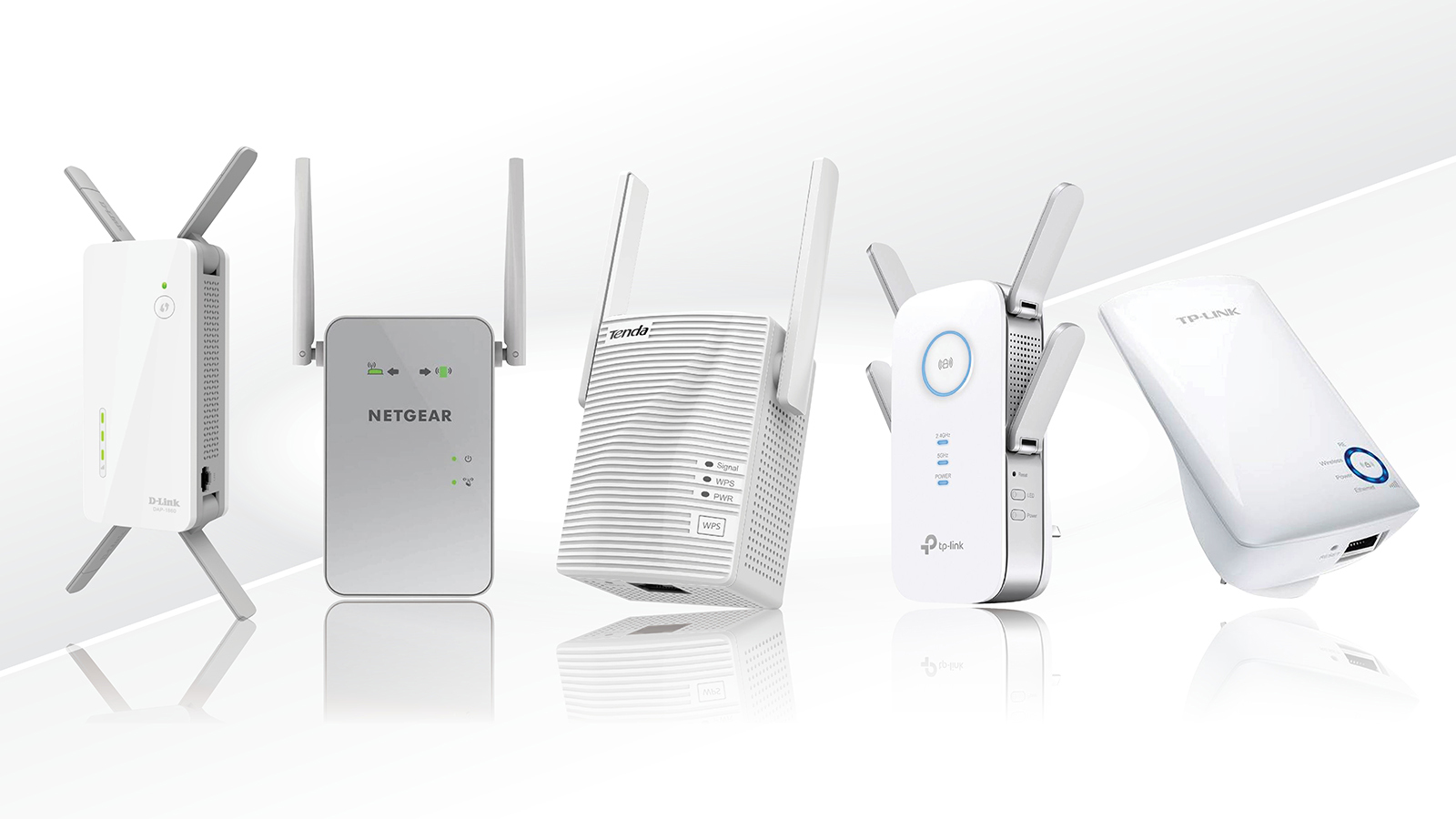
There are two main types of Wi-Fi range extender. The larger models, such as Netgear’s high-end Nighthawk series, look just like ordinary routers and are designed to sit on a desk or shelf.
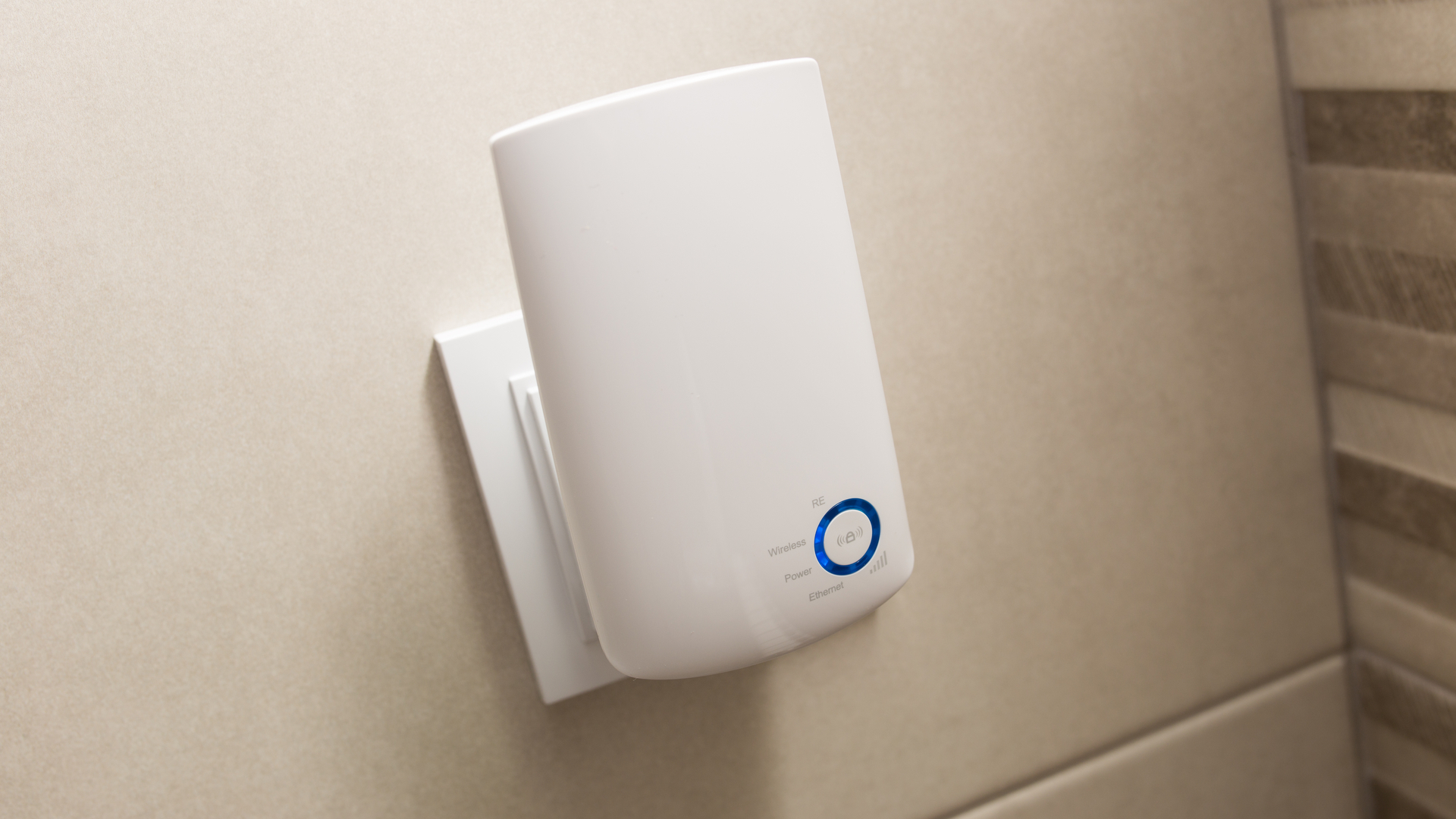
Then, there are also smaller models that plug directly into a mains power socket. The plug-in models are really convenient, but their compact design means that they may not have too many extra features.
A desktop range extender will be bigger, and will require a separate power cable for plugging into a nearby power socket, but that does give you more freedom in placing the range extender in a spot where it works best. Desktop models can also include additional features such as Ethernet ports for devices such as games consoles and smart-TVs that work better with a wired network connection.
The set-up process with range extenders varies from one manufacturer to another, although most range extenders now provide good apps to help you get started. The main thing to watch out for is that many range extenders set up a separate Wi-Fi network of their own, with its own name and password that are different from your main router’s network (the network name is often referred to as the ‘SSID’ - service set identifier - so watch out for that bit of jargon in the manual).
(Image credit: Shutterstock)
So, if the main Wi-Fi network in your home is called ‘Pete’s Wifi’, then you may have a range extender in an upstairs bedroom that creates its own network called ‘Mary’s Bedroom’.
If Mary takes her laptop up to the bedroom for a Zoom chat with her friends then she may have to manually select the new Wi-Fi network and enter the password before she can connect to that new Wi-Fi network in the bedroom.
That’s a bit tedious, so some newer ranger extenders can use the same network name and password as your existing Wi-Fi network, and this allows you to wander around your home so that your laptop or other devices automatically switch over to the range extender as you move further away from your main router.
There are a couple of other things to watch out for as well. Many range extenders, such as Devolo’s Magic kits, also include a feature called Powerline, which allows you to transmit your Internet connection over the electrical wiring in your home.
That’s always seemed like magic to us, and it’s really handy if you have a ‘deadspot’ in your home where the Wi-Fi just completely cuts out. Some of the latest range extenders also jump on the ‘whole home’ mesh bandwagon, calling themselves ‘mesh extenders’ and allowing you to create a wide-ranging new mesh network by linking several extenders together.
But, as we’ve pointed out, range extenders are designed to provide a more affordable and targeted Wi-Fi solution, so they’re best suited to homes where you just need to improve the Wi-Fi in one or two specific rooms or outdoor spots.
More than four million homes and businesses now have access to full fibre connectivity, according to new data released by Ofcom.
The regulator says 4.2 million properties are now connected to a full fibre network, a figure which represents 14 per cent of all UK premises. This is up from 12 per cent the last time the regulator released an update in the spring.
The vast majority of the UK’s broadband infrastructure is delivered by fibre the cabinet (FTTC) technology that uses copper for the final few metres of a connection.
However Openreach, Virgin Media and ‘altnets’ like Cityfibre, Hyperoptic and Gigaclear are all now investing in ‘full fibre’ networks. Meanwhile, the government itself has adopted a ‘fibre-by-default’ approach.
In terms of ultrafast broadband – a figure which Ofcom defines as in excess of 300Mbps and can include cable and fibre technologies – coverage is now up to 55 per cent thanks to the addition of 500,000 new properties.
Meanwhile, superfast broadband (at least 30Mbps) coverage remains at 95 per cent, while 98 per cent of all properties can get a ‘decent’ standard of connectivity. Ofcom defines ‘decent’ broadband as having transmission rates of 10Mbps download and 1Mbps upload. Recent regulation changes allow anyone in the UK to demand this minimum standard as part of the Universal Service Obligation.
Openreach currently plans to cover up to 20 million homes and businesses with fibre by the end of the decade, but says it could go further with a favourable investment climate. The government believes four fifths of the country will be covered by commercial deployments and has indicated it is willing to support measures that extend this coverage.
In terms of mobile coverage, Ofcom says the proportion remains static but it expects that the Shared Rural Network (SRN) framework will have a positive impact in the near future by allowing operators to share infrastructure in poorly-served areas.
The next update will be in December when Ofcom publishes its annual Connected Nations report. It is expected that publication will offer some insight into how the Coronavirus pandemic affected the UK’s network infrastructure.
At the height of lockdown, Openreach only carried out ‘essential’ repairs and maintenance in order to minimise social contact and protect the public and its engineers.
Vodafone is using a Virtual Reality (VR) digital learning application to showcase the virtues of standalone 5G (SA 5G), marking the first time the technology has been used commercially in the UK.
Nearly all commercial 5G deployments to date have relied on Non-standalone 5G (NSA 5G), which uses new radio technologies but still relies on the underlying 5G core.
SA 5G uses a new virtual, cloud-based core that allows data to be processed closer to the point of collection and enables features like network slicing. This allows for guaranteed speeds, enhanced reliability and ultra-low latency.
These characteristics will be essential for some of the most revolutionary 5G applications – including the Industrial Internet of Things (IIoT).
Vodafone built a SA 5G network at the University of Coventry earlier this year, hoping to test future teaching technologies.
The first fruit of this partnership is an application for medical students that allows lecturers to use Nvidia’s Cloud XR technology to provide a real-time, interactive tour of the human body. Students access the lesson via any device – smartphone, laptop or tablet.
While digital lessons like this have been possible in the past, they have had to be pre-recorded, linear sessions. The low latency features of SA 5G means lecturers can interact with the body in real time and use a headset with a smartphone, rather than tether to a PC. Meanwhile, students can ask questions in real time, improving the effectiveness of teaching.
“Coventry University is always looking at ways of pushing the boundaries of teaching and learning to improve the student experience,” said Dr Natasha Taylor, an associate professor at Coventry University’s Faculty of Health and Life Sciences.
“I can put the headset on, and 5G allows the learner to access high-resolution images and videos remotely, anywhere in the world, and [they] are able to ask questions in real-time.”
The university says digital learning will never replace in-person teaching, but will instead complement it. Such applications will have particular value in the upcoming academic year as universities adjust to lockdown restrictions. Many institutions are advocates of ‘flexible’ learning which will see students participate in a combination of digital and in-person instruction.
Google says its new Wi-Fi platform will make it easier for mobile operators to seamlessly offload traffic onto public wireless networks and enhance indoor coverage.
Venues such as shopping centres and train stations have long recognised the importance of providing visitors with connectivity. An inability to access mobile data services can cause frustration and discourage repeat visits.
However indoor coverage can be a challenge for some mobile operators without the use of low level spectrum that can penetrate walls more effectively or without the use of small cells that provide high capacity bandwidth over a limited area.
Many major venues have therefore taken issues into their own hands and built commercial-grade public Wi-Fi networks that offer a connection and have the added benefit of collecting certain types of data that can be used to improve the business.
The issue is that users themselves have to take action and fragmented registration processes make the experience less than seamless.
‘Orion Wifi’, a graduate from Google’s in-house ‘Area 120’ incubator, allows venues such as shopping centres and train stations to sell excess Wi-Fi capacity to operators, with the authentication and onloading process done in the background.
“With Orion Wifi … your carrier can automatically and securely connect you to the Wi-Fi,” said Raj Gajwani, Director, Area 120. “Although you don’t lift a finger, there’s a lot happening in the background. . If the carrier decides the connection is good enough, we’ll auto-connect you. If the quality is too low, we won’t. When you are connected, Internet traffic flows over the Wi-Fi network just as if you had connected directly to the Wi-Fi; Orion cannot access users’ Internet traffic.”
Orion is now available to US public venues and Google is working with major equipment vendors to ensure compatibility. It is also seeking compatibility with the ‘OpenRoaming’ standard pioneered by Cisco and adopted by the Wireless Broadband Alliance (WBA).
“Orion Wifi works with most commercial and enterprise Wi-Fi systems, usually with no new hardware or software. Orion Wifi helps improve connectivity even for venues that have already deployed Distributed Antenna Systems (DAS) or Small Cells to improve coverage,” added Gajwani.
It is hoped that 5G will remedy many of the shortcomings of existing cellular networks. Operators plan to use low-level spectrum that has longer range and better propagation characteristics, while network densification programmes will see small cells become mainstream. Meanwhile, 5G could offer superior speeds to wireless and could eventually erode its current advantage in battery consumption.
Samsung has secured a major 5G contract with US operator Verizon in a partnership that could shake up the global telecoms equipment market.
The Korean electronics giant has spent much of the past decade as the world’s leading smartphone manufacturer and is a major supplier of components to the industry. However expansion has proved difficult due to market saturation, a lack of new markets to target, and longer refresh cycles.
This has led to the ambition to come a significant player elsewhere in the ecosystem, specifically telecoms equipment.
Samsung’s presence is limited at present, but it hopes to expand its share in the 5G era. There is strong demand in its native South Korea and US and other countries where Huawei has been excluded for the market could provide more opportunities.
The size of the deal with Verizon is a big step forward in that regard. Reports suggest the contract is worth 7.9 trillion won ($6.6 billion) and lasts for five years. The revenues will not only provide a boost to Samsung’s networking business but increase its profile and install confidence in other operators around the world.
“With this latest long-term strategic contract, we will continue to push the boundaries of 5G innovation to enhance mobile experiences for Verizon’s customers,” Samsung is quoted as saying.
The ban on Huawei kit in certain countries is a boost to Huawei’s rivals Ericsson and Nokia but there is hope that other firms – such as Samsung – will ensure the continuation of a diverse supplier pool that drives competition.
Samsung told MPs in the UK in July that Samsung could “definitely” step in to help UK operators while the government is also courting Japanese vendor NEC.

Follow Us
Were this world an endless plain, and by sailing eastward we could for ever reach new distances